
Bugs in northwest Houston change with the seasons, but they never really take one off. Around Cypress, spring brings termite swarms and fire ant mounds, summer belongs to mosquitoes, wasps and the big roaches that come in after rain, and fall and winter push mice and roof rats toward the attic. Below is each season with the pests that peak in it, the signs to look for, and what to do.
Quick answer
Spring: termite swarms, which Texas A&M AgriLife says are most common from February through May, and fire ant mounds after rain. Summer: mosquitoes, paper wasps and yellowjackets, and large cockroaches that come inside during and after rain. Fall: yellowjacket colonies at their largest, and mice and roof rats moving in as it cools. Winter: rodents in the attic and German cockroaches, which live indoors all year.
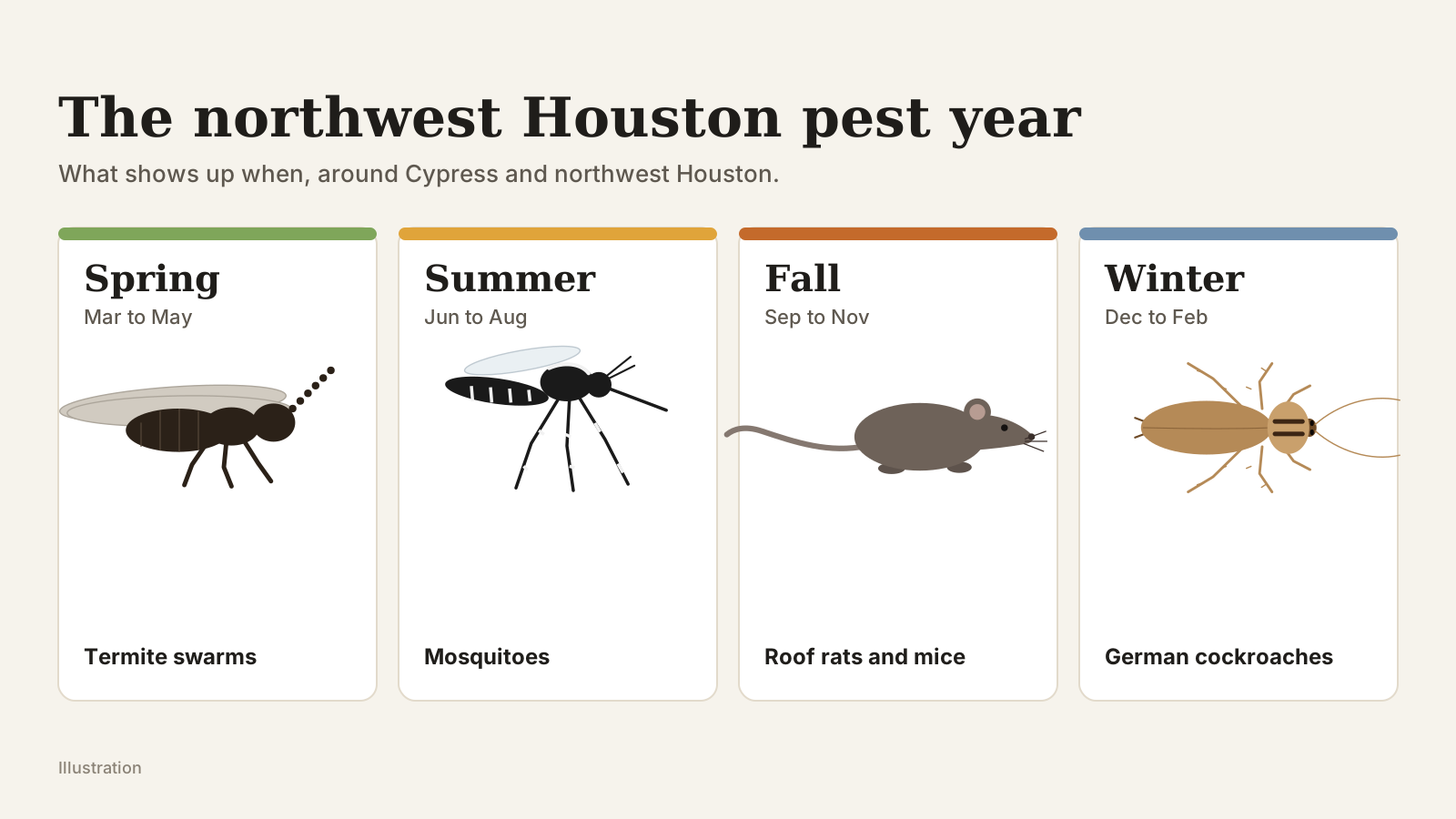
The northwest Houston pest year
Spring (Mar to May)
- Termite swarms
- Fire ant mounds
- Swarming ants
Summer (Jun to Aug)
- Mosquitoes
- Paper wasps and yellowjackets
- American cockroaches after rain
Fall (Sep to Nov)
- Mice and roof rats
- Yellowjackets
- Late mosquitoes
Winter (Dec to Feb)
- Rodents in the attic
- German cockroaches
- First termite swarms
A guide, not a schedule. Rain, a warm winter or a cold snap can move any of these, and rodents and German cockroaches turn up in every month.
What are you seeing?
- Winged insects at a window, or wings on the sill, February to May
- Termite swarmers or swarming ants. Termites have a straight body and four wings of equal length; ants are pinched at the waist and their front wings are longer. Spring.
- Small winged insects around a light on a late-May or early-June night
- Formosan subterranean termites, which swarm at night and fly to lights. Late spring.
- A mound of fluffy soil in the lawn a few days after a hard rain, with no hole on top
- Red imported fire ants. New mounds pop up with spring rain and warmer weather.
- Black-and-white mosquitoes biting in the shade in the middle of the day
- Container mosquitoes such as the Asian tiger mosquito, which breed in water standing in buckets, tires and gutters. Summer.
- Large reddish-brown roaches in the bathroom after heavy rain
- American cockroaches, which live in sewers and come up through drains, and head indoors during and after rain. Summer.
- Wasps going in and out of a hole in the ground or a wall
- Yellowjackets. Colonies are at their largest by August or September. Late summer and fall.
- Footsteps or scratching in the ceiling or attic, or droppings
- Roof rats or mice. Fall and winter most of all, but rodent work turns up in every month.
- Light-brown roaches in the kitchen with two dark stripes behind the head
- German cockroaches. They live indoors, so any month.
- Tiny pellets piling up under wood trim or furniture
- Possibly drywood termites, which Texas A&M says are most concentrated along the Gulf Coast. Any season.
Dealing with this right now?
Termites at the window, wasps under the eaves or something in the attic? Stampede will identify it and treat it, across Cypress and northwest Houston.
The four seasons, one by one
Spring (March to May)
Termite swarms, fire ants, swarming ants
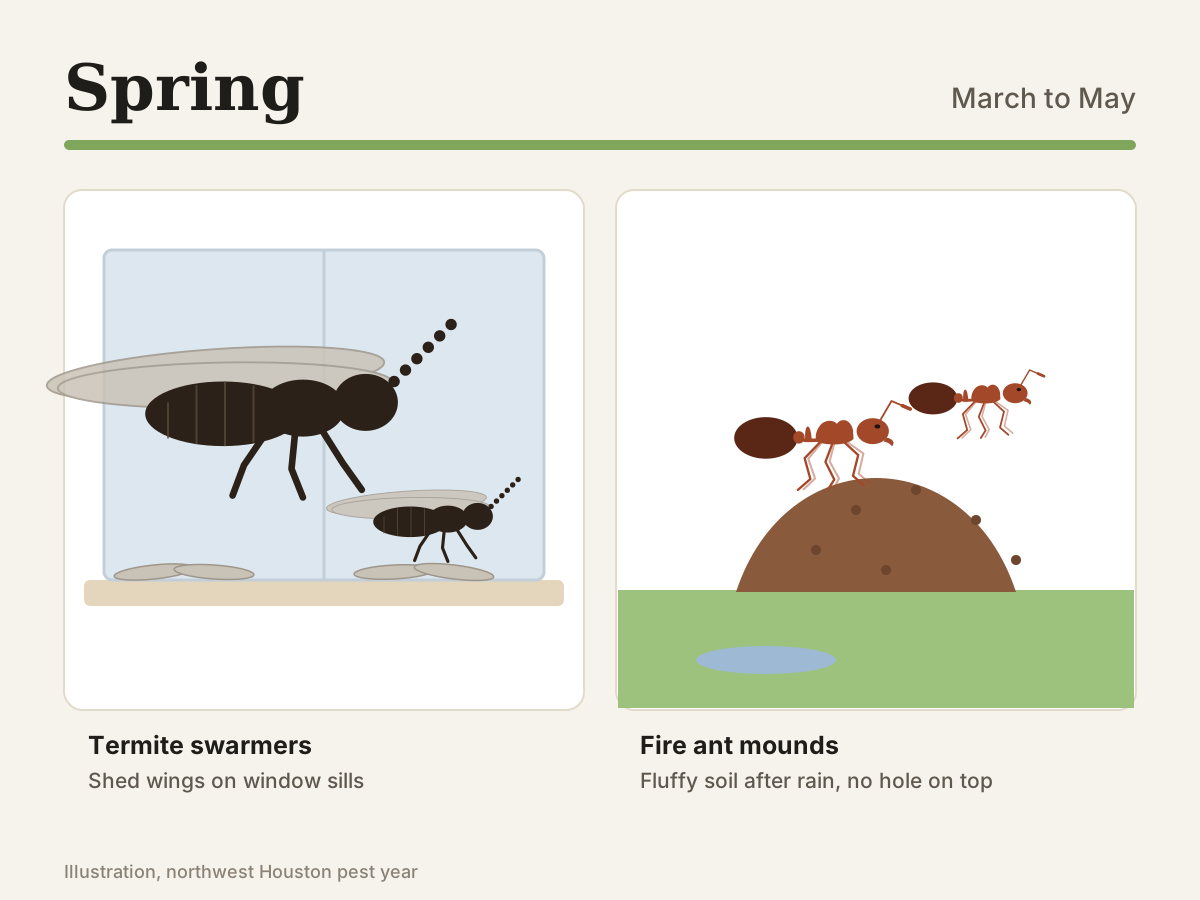
Spring is termite swarm season. Texas A&M AgriLife says swarms are most common from February through May in Texas, starting earliest in the south of the state. Native subterranean swarmers are about 1/4 to 3/8 inch long, colored anywhere from black to pale yellow-brown, and leave their wings on window sills and in cobwebs. Formosan termites, first found in Texas in 1956 near the Houston Ship Channel in Pasadena, swarm at night in late May and early June and fly toward lights.
Ants swarm at the same time of year, so check the waist: a termite has a straight body and four wings of equal length, while an ant is pinched in the middle and its front wings are longer. Fire ants wake up too. Texas A&M says their foraging does not start in earnest until the soil reaches about 70 degrees, and new mounds of fluffy, worked soil with no opening on top appear a few days after a heavy rain.
What to do: Termite swarmers inside the house usually mean an active infestation in the structure, so they are worth a termite inspection. For fire ants, Texas A&M's standard advice is to hold off on yard-wide bait until late April or May, when the ants are foraging; for a yard that keeps rebuilding mounds, see ant control.
Summer (June to August)
Mosquitoes, wasps, big roaches after rain
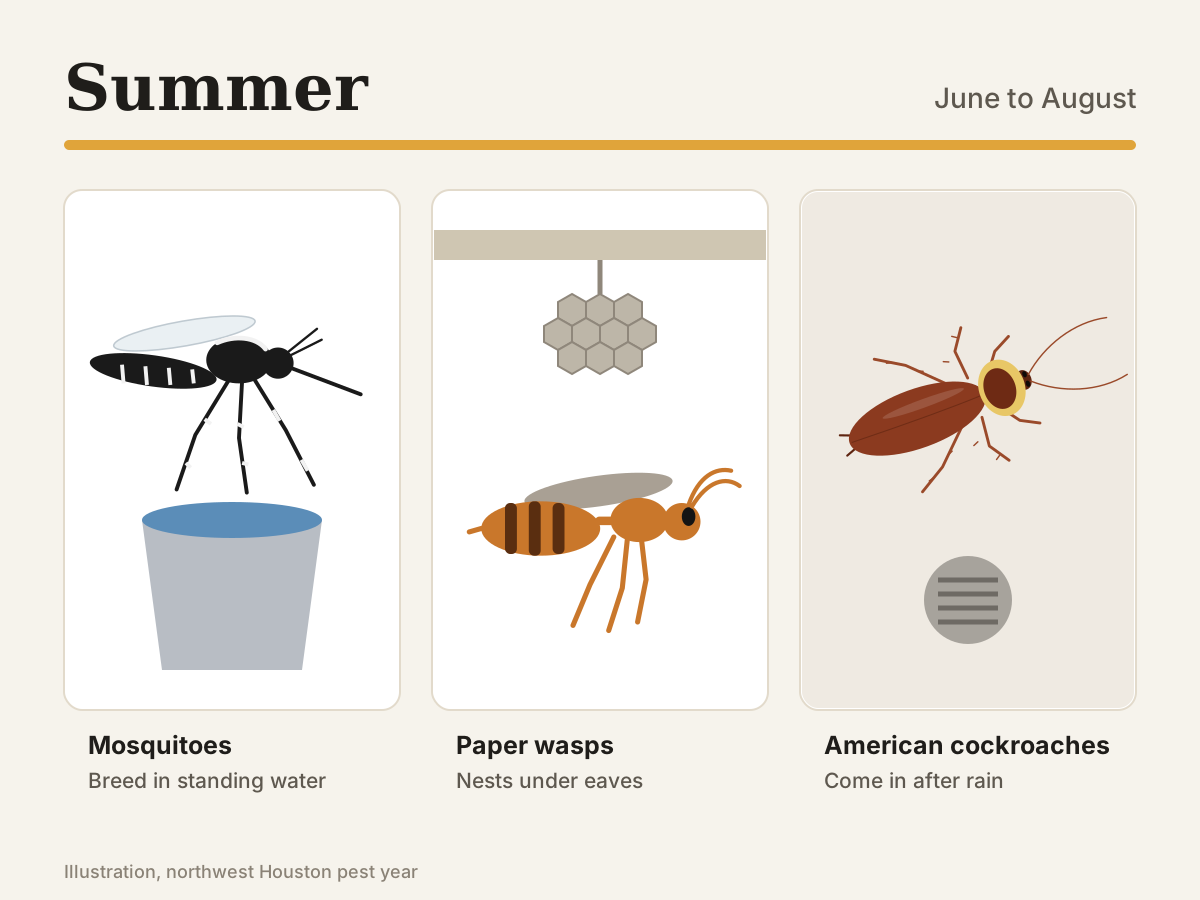
Summer belongs to mosquitoes, and they come in waves after rain. Texas A&M AgriLife entomologist Sonja Swiger describes floodwater mosquitoes first, aggressive biters from dawn to dusk; then container mosquitoes, black and white with striped legs, that breed in buckets, tires and gutters and bite mainly in the daytime, especially in shade; then Culex mosquitoes from stagnant water as it dries out. AgriLife's Mike Merchant names West Nile virus, carried by night-flying mosquitoes, as the biggest human threat from mosquitoes.
Wasps build through the summer. Paper wasp nests, most often under the eaves, are started in spring by queens that spent the winter in sheltered spots, and yellowjacket colonies grow to their largest by August or September, usually in the ground, sometimes in a wall void. Rain brings in the big roaches: AgriLife notes that large outdoor cockroaches head indoors during and shortly after rain, and American cockroaches, reddish-brown and 1 1/2 to 2 inches long, travel the sewer lines and come up through drains.
What to do: After every rain, empty, cover or remove anything holding water, as Harris County Public Health advises, and use an EPA-registered repellent outdoors. Leave yellowjacket nests alone and mark the spot so no one walks into it. For a yard you want to use, see mosquito control in Cypress; for a nest near a door or play area, see wasp removal.
Seeing one of these at home?
Stampede is based in Cypress and treats homes across northwest Houston. Tell us what you are seeing, and a technician will identify it and treat where it lives.
Fall (September to November)
Mice and roof rats, yellowjackets, fire ant baiting
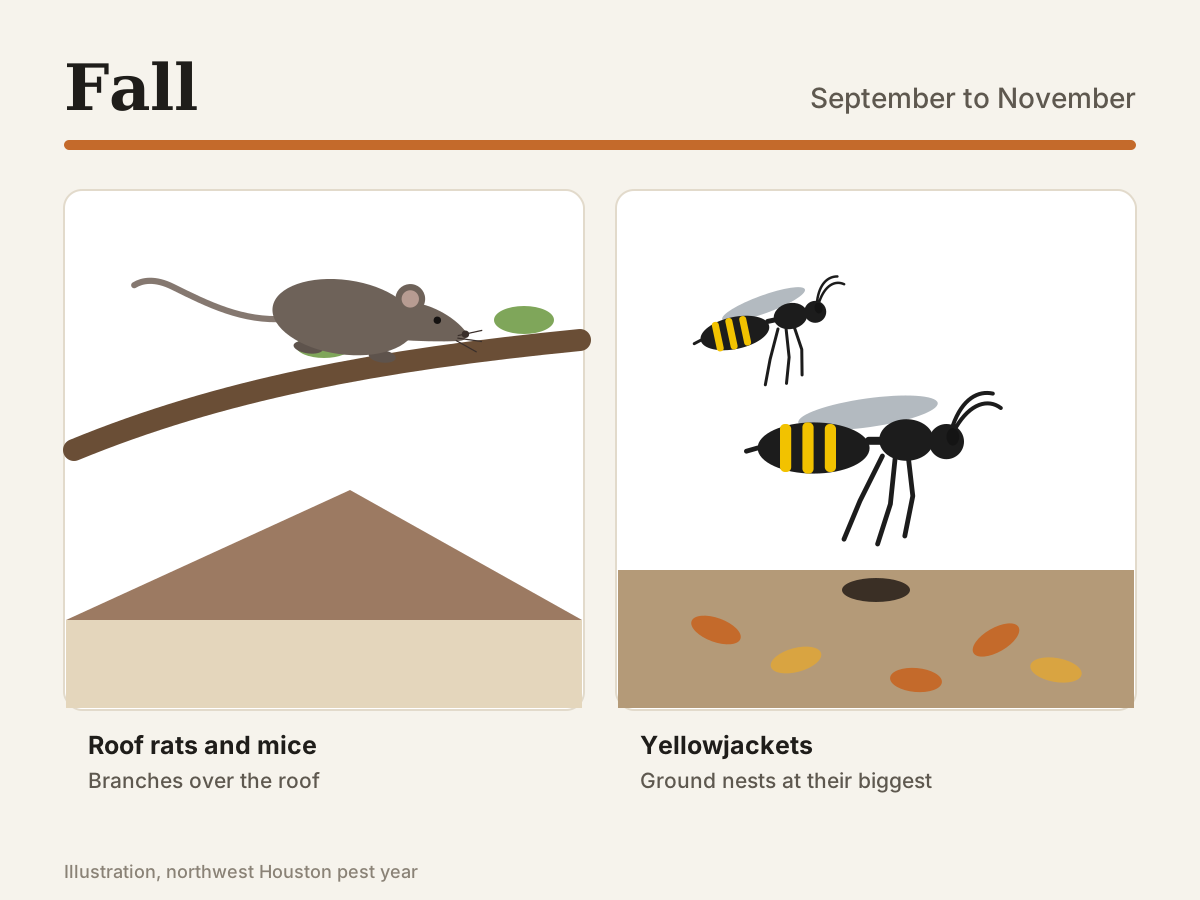
Fall is when rodents look for a way in. Texas A&M's school pest program notes that mouse problems can come at any time of year but especially in fall, when outdoor temperatures start to cool. Roof rats are climbers that live in attics and roof spaces and usually get in from overhanging trees or power lines, and an opening as small as 1/4 inch draws mice, 1/2 inch rats. Spiders and scorpions also move indoors as the weather cools.
Yellowjackets are at their worst now: Texas A&M says colonies are most often a problem in late summer and fall, and they raise next year's queens in October and November. Mosquitoes keep going too; the Texas Department of State Health Services says they stay active in much of Texas into November and December. Fall is also when Texas A&M's fire ant program suggests broadcasting bait over the whole yard, between late August and mid-October, so it works through the winter.
What to do: Trim branches and shrubs so they do not touch or overhang the house, and seal gaps around pipes and wires with caulk or foam. If you already hear something overhead, see rodent control in Cypress. Fire ant bait goes down when the ground is dry and no rain is expected for 24 to 48 hours; ant control covers the whole yard.
Winter (December to February)
Rodents in the attic, German roaches, first termites
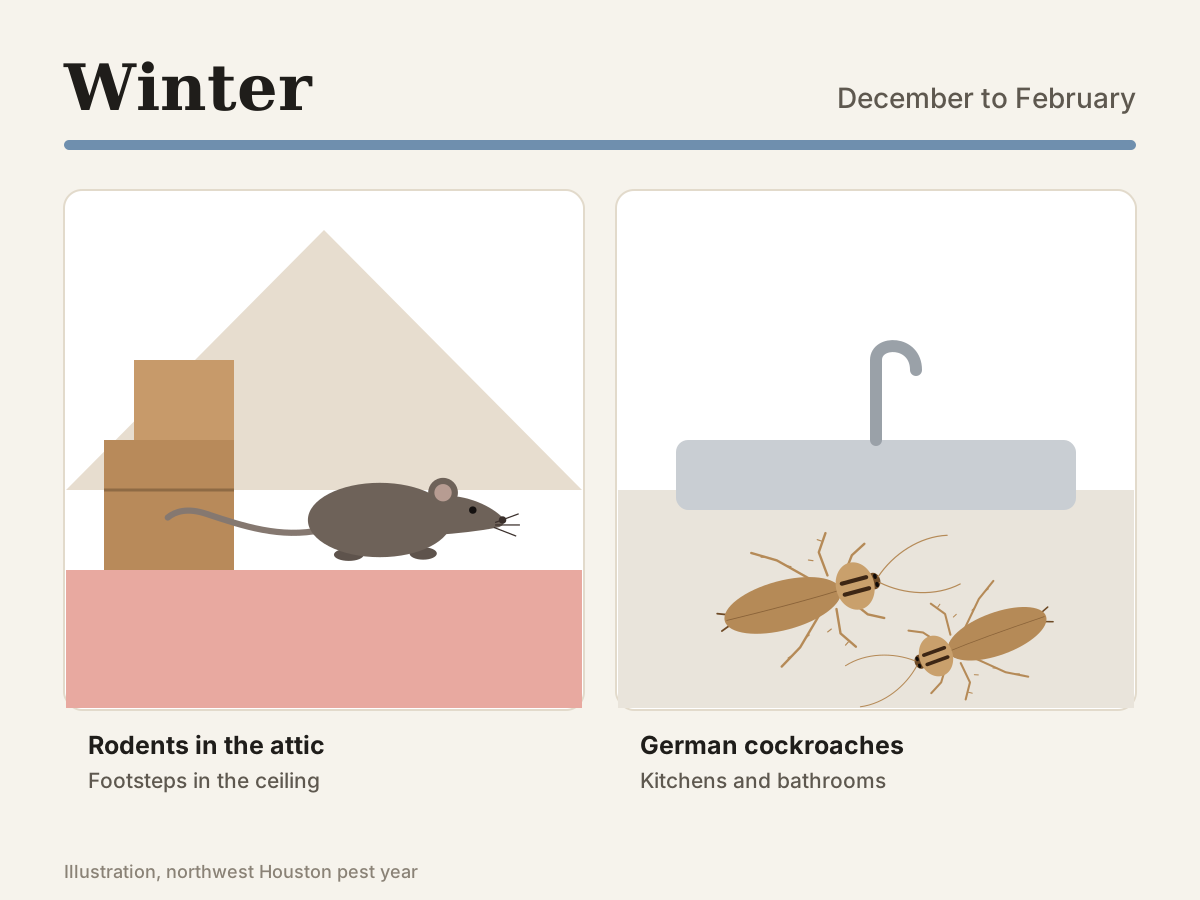
Winter is quieter outside, but the pests already indoors stay busy. Texas A&M calls roof rats quite common in east Texas cities, and footsteps in the ceiling or attic, droppings and gnaw marks are the usual signs; rats can also chew wiring. Our own count of Houston-area service visits found rodent work in every month from January 2025 through September 2026, so cold weather is not the only time to deal with it.
German cockroaches pay no attention to the weather. Texas A&M describes them as an indoor pest that hides near moisture and food in kitchens and bathrooms: light brown, about 1/2 to 5/8 inch long, with two dark stripes on the shield behind the head, and quick to multiply. Late winter also brings the first termite swarms; in South Texas, Texas A&M says they can start in January and February.
What to do: For rodents in the attic, Texas A&M's first step is to find and seal the likely entry points, then set more snap traps than you think you need (triple is its rule of thumb) where you find droppings. German roaches respond to baits placed where they live. See rat removal in Houston or German cockroach control.
Why the seasons blur here
The calendar above is a guide, not a schedule. Harris County Public Health monitors adult mosquitoes year-round, not only in summer, and the state health department says mosquitoes stay active in much of Texas into November and December. Rodents and German roaches do not follow the seasons either; our visit counts for both are in Is there a rat and roach season in Houston?
Rain moves the calendar more than the date does. Texas A&M ties new fire ant mounds and mosquito booms to heavy rain, and large outdoor roaches come inside during and shortly after rain. After a wet week, walk the yard and check for anything holding water and for fresh mounds, whatever the month. For the termite side of the year in more detail, see termite season in Texas and when termites swarm.
When to call for help
Texas A&M's advice on termites is to have a professional inspect the house if you suspect them, because swarmers indoors are a reliable sign of an infestation. On wasps, it warns that nest control is dangerous and that anyone unsure about handling a nest should call a professional.
For anything else on this calendar, contact us or call (281) 972-4612, and we will identify it and tell you what it needs.
Related
Sources
- Texas A&M AgriLife Extension: Frequently asked questions about subterranean termite control (ENT-2002)
- Texas A&M Urban and Structural Entomology: Native subterranean termites
- Texas A&M Urban and Structural Entomology: Formosan subterranean termites
- Texas A&M Urban and Structural Entomology: Drywood termites
- Texas A&M AgriLife: How can I tell if I have fire ants?
- Insects in the City (Texas A&M AgriLife): Fire ant season reminders (2011)
- Insects in the City (Texas A&M AgriLife): Time to bait for fire ants (2014)
- Texas A&M AgriLife fire ant program: Two-step method
- Insects in the City (Texas A&M AgriLife): Mosquito populations booming after rains (2021)
- Texas A&M Mosquito Safari: Aedes albopictus (Asian tiger mosquito)
- Texas IPM Program (Texas A&M AgriLife): Floating fire ants, insect pests among flood hazards (2017)
- Harris County Public Health: Mosquito and vector-borne resources
- Harris County Public Health: Mosquito and Vector Control surveillance
- Harris County Public Health: Report an issue to Mosquito and Vector Control
- Texas Department of State Health Services: First Texas case of West Nile virus highlights need for mosquito precautions (2024)
- Texas A&M AgriLife Extension: Paper wasps, yellowjackets and solitary wasps (ENTO-PU-023)
- Insects in the City (Texas A&M AgriLife): Southern yellowjacket (2014)
- Texas A&M Urban and Structural Entomology: American cockroach
- Texas A&M AgriLife Extension, Bexar County: Rainy weather brings home-invading insects to the limelight (2004)
- Texas A&M AgriLife School IPM: IPM action plan for rodents
- Insects in the City (Texas A&M AgriLife): Rodents in attics (2016)
- Texas A&M AgriLife fire ant program: Cooler temperatures often move critters inside (2012)
- Texas A&M Urban and Structural Entomology: German cockroach